Sclerotherapy at Me Clinic
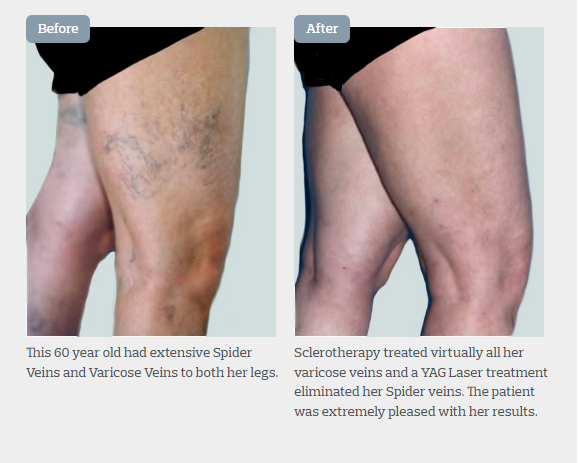
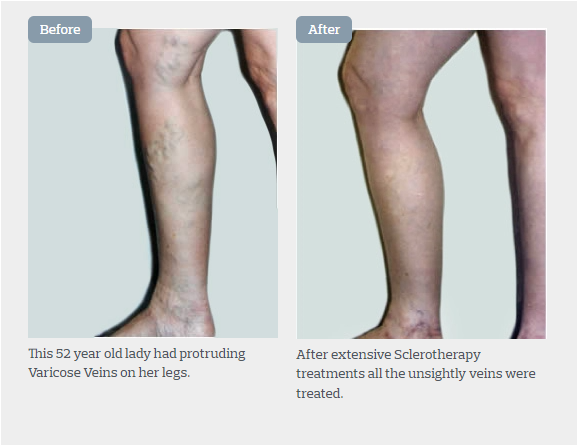
Sclerotherapy is a minimally invasive treatment for varicose and spider veins. A solution called a sclerosant is injected into the affected vein through very fine micro-needles. The solution irritates the vein lining, causing the vein to close and contract. Blood is redirected through healthier veins and the treated vein gradually fades.
It is one of the most commonly used vein treatments, but it is only appropriate for veins at certain stages. Whether it suits your case depends on the size, depth and location of the veins, and on what an assessment finds.
What sclerotherapy is used for
- Certain varicose veins and tributary veins.
- Smaller accessory veins, where treatment can be preventative — addressing veins before they enlarge and bulge into varicose veins.
- Spider veins, using visual sclerotherapy.
- Treatment plans where multiple areas need staged treatment, often across more than one session.
Larger refluxing trunk veins are generally better addressed with endovenous laser ablation or VenaSeal. Sclerotherapy is frequently used alongside those treatments rather than instead of them.
Types of sclerotherapy
Visual sclerotherapy
Used for smaller varicose veins and spider veins that are visible at the surface, and injected under direct vision.
Foam sclerotherapy
Used for larger varicose veins. The sclerosant is prepared as a foam rather than a liquid. Foam is generally preferred because less solution is required to achieve the result, it is visible under ultrasound so the treatment can be monitored as it is delivered, and it typically causes less discomfort with more rapid healing.
Ultrasound-guided sclerotherapy
Used where veins are not visible at the surface, or connect to deeper feeder veins. Ultrasound imaging is used to target the correct vein. Me Clinic often prioritises ultrasound-guided sclerotherapy for more thorough and consistent treatment of varicose veins.
Which one, for which vein
| Visual | Foam | Ultrasound-guided | |
|---|---|---|---|
| Vein type | Spider and small surface veins | Larger varicose veins | Veins not visible at the surface, and feeder veins |
| How it is targeted | By eye | By eye or ultrasound | By ultrasound throughout |
| Form of sclerosant | Usually liquid | Foam | Usually foam |
| Why it is chosen | Direct, precise on fine vessels | Displaces blood so the solution reaches the wall; less solution needed | The only way to treat what cannot be seen |
| Indicative cost | From $470 per session | From $740 per session | |
Most treatment plans use more than one of these, and often alongside a trunk treatment. Which applies to you comes out of the ultrasound, not out of a price list.
Assessment before treatment
A consultation establishes the severity and source of the problem. Where the veins are larger, symptoms are significant, or the source vein is not obvious, duplex ultrasound is used to map reflux and plan treatment.
This matters because treating surface veins without identifying an underlying refluxing vein tends to give a poorer and shorter-lived result.
What a session is actually like
Nobody describes this, and it is the thing people are most uncertain about. It is a clinic appointment, not an operation.
- You stand up and the veins are marked. Leg veins fill by gravity, so they are identified while you are upright — they largely disappear once you lie down.
- You lie on a couch and the skin is cleaned.
- The injections are given through very fine micro-needles. There may be a lot of them — treating a network of spider veins can mean dozens of tiny injections in a session, which sounds worse than it is.
- It stings briefly. Most people describe a small sharp scratch and then a short burning or cramping sensation as the solution goes in, settling within seconds. No anaesthetic is generally needed.
- Compression goes on — bandages, stockings, or both.
- You walk, usually for a short period before leaving and then as advised at home.
- You drive yourself home and carry on with the day.
A session generally takes well under an hour depending on how much is being treated. Wear or bring loose trousers that will go over bandages, and shoes you can manage.
One practical note: do not moisturise your legs on the day, because stockings and tape do not adhere well to moisturised skin. And do not shave immediately beforehand — the day before is better.
What to expect afterwards
Sclerotherapy typically requires less downtime than more invasive vein treatments, though individual experiences vary.
- Some bruising is expected.
- Veins may temporarily look worse before they look better. This is normal.
- Tenderness and redness after treatment are normal.
- Support hosiery is generally worn afterwards, as directed.
Walking rather than sitting after treatment helps reduce soreness, and an oral anti-inflammatory can help further. Walking up to 30 minutes a day is recommended. Most people can continue with normal activities.
Avoid vigorous exercise in the first 24 hours, and avoid long car or plane trips over the same period.
How long until it looks different
| When | What is usually happening |
|---|---|
| Days 1 to 7 | Bruising; treated veins often darker; itching; tenderness. Worse-looking than before treatment |
| Weeks 2 to 6 | Bruising fading; any brown staining at its most obvious; firm lumps may appear and be released at review |
| Weeks 6 to 12 | The first honest look at that session — and when the next is usually considered |
| Months 3 to 12 | Staining fading; the settled result of the course |
Do not judge at two weeks. Almost every disappointed reaction to sclerotherapy happens in the window where bruising and pigment are at their peak and the vein has not yet been cleared.
Matting: the fine blush that sometimes appears
Occasionally a patch of very fine new red vessels appears near a treated area in the weeks afterwards — finer than the veins that were treated, in a blush rather than a line. This is matting, and it is worth knowing about in advance because it is alarming when it is unexpected.
- It is uncommon, and it is not a sign that something went wrong.
- It often settles on its own over several months.
- It is more likely where treatment has been aggressive, where a large amount was injected into one area, or where a feeding vein higher up was not addressed.
- Treating it harder is the wrong instinct. Raise it and let it be assessed — sometimes the answer is an untreated feeder vein, and sometimes it is time.
It is also one of the reasons a sensible course is spaced and conservative rather than maximal in one sitting.
Why results vary
Where sclerotherapy has been less effective, the contributing factors are usually one of the following:
- Incorrect diagnosis of the underlying problem.
- Ineffective closure of the offending veins.
- Not wearing the support hosiery after treatment.
- Rapid development of new veins, which can be genetically related.
- New veins developing over time irrespective of the treatment method used.
Individual results may vary. More than one session is often required, and new veins can appear over time regardless of how well the original treatment worked. Assessment, correct technique and follow-up matter as much as the injection itself.
What you control, and what you do not
| Within your control | Not within your control |
|---|---|
| Wearing compression exactly as directed — the most common avoidable cause of a poor result | Your genetics, which largely determine how readily new veins form |
| Walking daily, and not sitting still for long periods | How readily your skin pigments |
| Attending follow-up, where trapped blood is released and staining reduced | How many sessions your particular veins need |
| Completing the course rather than stopping when it looks worse at week two | Whether a trunk vein was refluxing in the first place |
| Giving an accurate history, so the right diagnosis is made | |
| Sun protection on treated legs, which reduces staining |
The left-hand column is short and it is genuinely decisive. Most of the difference between a good result and a mediocre one sits there.
Who this suits, and who it does not
It tends to suit: people with spider veins, reticular veins, tributary and smaller varicose veins; people whose ultrasound has been done and whose trunk reflux is being addressed; people able to walk and to wear compression.
It tends not to suit, or needs something else first:
- Anyone with a large refluxing trunk vein that has not been assessed — treat that first, or the branches refill
- Anyone with a known allergy to the sclerosant
- Anyone with a current deep vein thrombosis or untreated clotting disorder
- Anyone with significant arterial disease in the legs, where compression may not be safe
- Anyone unable to walk or immobile
- Anyone pregnant — treatment is generally deferred, and pregnancy-related veins often improve afterwards
- Anyone with active infection or broken skin over the area
Tell your doctor about any previous DVT or pulmonary embolism, clotting disorders, hormone therapy or the contraceptive pill, migraine with aura, and a known hole in the heart. Each changes the plan.
Costs
As at September 2024 and including GST:
- Vein consultation with a doctor, which may include ultrasound — $230. If you proceed with treatment on the day of the consultation, the consultation fee may be waived.
- Sclerotherapy treatment session — from $470.
- Ultrasound-guided sclerotherapy session — from $740.
Cost varies with the number of veins treated, the number of sessions required and the complexity of the treatment. Sclerotherapy typically costs less than varicose vein surgery. See varicose vein treatment costs for the full breakdown.
Two things to factor in beyond the session price: compression stockings, usually an additional cost and not optional, and the fact that this is a course rather than an appointment. Ask for the likely number of sessions and the likely total, and what maintenance tends to look like afterwards. We are not a no-gap provider.
Medicare
You may be able to claim a Medicare rebate for vein treatment. Your physician will discuss any applicable rebates at your initial consultation, and you can contact Medicare directly for further detail. A valid GP referral supports a claim.
Broadly, a rebate is possible where treatment is for a medical reason — duplex ultrasound showing reflux together with symptoms or complications such as aching, swelling, skin changes, bleeding or ulceration — rather than for appearance alone. Treatment of small surface spider veins for appearance does not qualify. Get the GP referral before your first appointment, describe your symptoms accurately rather than playing them down, and ask for the cost both with and without a rebate. Item numbers and criteria change, and eligibility is a clinical judgement made at consultation.
Risks
All procedures carry some risk. Sclerotherapy does not generally require anaesthetic. Bruising, tenderness, redness and temporary worsening of appearance are expected rather than complications. Risks are discussed with you in detail at consultation, and you are given written information to take home.
Recognised risks include brown or tan staining along a treated vein which usually fades over months but occasionally persists; matting; firm tender lumps of trapped blood; blistering and rarely ulceration at an injection site; allergic reaction, rarely including anaphylaxis; infection; inflammation of the treated vein; deep vein thrombosis and rarely pulmonary embolism; transient visual disturbance or migraine-like symptoms reported particularly with foam; nerve irritation causing a patch of numbness; incomplete closure requiring further sessions; and recurrence.
Please read our information on the risks and complications of cosmetic surgery before proceeding.
Any surgical or invasive procedure carries risks. Before proceeding you should seek a second opinion from an appropriately qualified health practitioner.
Expected, versus call us, versus emergency
- Expected: bruising; treated veins looking darker or worse before they improve; tenderness, redness and itching; firm lumps along treated veins; mild aching relieved by walking.
- Call us: blisters; a lump that is very tender or growing; spreading redness, heat or pus; an area of skin breaking down; a new fine blush of vessels near a treated area; brown staining you want assessed; discomfort that is not settling.
- Emergency — call 000 or go to an emergency department: sudden breathlessness or chest pain; a calf or thigh that becomes swollen, hot and painful; widespread rash, facial or throat swelling, or difficulty breathing after an injection.
What you should leave with
- Your ultrasound findings in plain terms, and whether a trunk vein needs treating
- Which type of sclerotherapy, and how many sessions are likely
- How long to wear compression, and where to get correctly fitted stockings
- Written aftercare and the signs to call about
- A follow-up appointment — the one where trapped blood is released
- The likely total cost, and whether a rebate applies
- An after-hours contact number
Who performs sclerotherapy
Dr Tim French (MED0001790529) practises in phlebology, holds AHPRA registration and has over a decade of clinical experience in venous medicine. He holds an MBBS, a Diploma of Surgical Anatomy (University of Melbourne), and further qualifications in phlebology and ultrasound in phlebology.
One point of accuracy: phlebology is not an AHPRA-recognised medical specialty in Australia. Doctors practising in it hold general or specialist registration in a recognised field alongside additional training in venous medicine. Registration and any conditions on it can be checked free of charge on the AHPRA public register.
We are at 4 Burke Road, Malvern East VIC 3145, five minutes’ walk from Caulfield station. Phone 1300 852 050, or use the online consultation form.
Related: vein treatments, sclerotherapy for varicose veins, spider veins, ultrasound-guided sclerotherapy.
Individual results may vary. Any surgical or invasive procedure carries risks. Before proceeding you should seek a second opinion from an appropriately qualified health practitioner.
Common questions about sclerotherapy
What is sclerotherapy?
A sclerosant solution injected into a vein through very fine micro-needles. It irritates the vein lining so the vein closes and contracts, blood is redirected through healthier veins, and the treated vein gradually fades.
What is it used for?
Certain varicose and tributary veins, smaller accessory veins where treating early prevents them enlarging, spider veins, and staged plans across more than one session.
What is it not used for?
Larger refluxing trunk veins, which are generally better addressed with endovenous laser ablation or VenaSeal — often with sclerotherapy alongside rather than instead.
What is the difference between visual, foam and ultrasound-guided?
Visual treats surface veins by eye. Foam uses the sclerosant as a foam for larger veins — less solution needed, visible on ultrasound, usually less discomfort. Ultrasound-guided targets veins that cannot be seen at the surface.
Why is an ultrasound done first?
Because treating surface veins without identifying an underlying refluxing vein gives a poorer and shorter-lived result.
What happens in a session?
Veins are marked while you stand, you lie down, the injections are given through fine micro-needles, compression goes on, and you walk. It generally takes well under an hour and you drive yourself home.
Does it hurt?
A small sharp scratch and then a short burning or cramping sensation as the solution goes in, settling within seconds. No anaesthetic is generally needed.
How many injections will I have?
Potentially a lot — treating a network of spider veins can mean dozens of tiny injections in a session, which sounds worse than it is.
What should I do on the day?
Wear or bring loose trousers that go over bandages and manageable shoes. Do not moisturise your legs that day — stockings and tape do not adhere to moisturised skin — and shave the day before rather than immediately beforehand.
What is normal afterwards?
Bruising, tenderness and redness, veins temporarily looking worse before they look better, and support hosiery worn as directed.
What should I do afterwards?
Walk rather than sit — up to 30 minutes a day — and avoid vigorous exercise and long car or plane trips for the first 24 hours. An oral anti-inflammatory can help with soreness.
When should I judge the result?
Six to twelve weeks after a session. Do not judge at two weeks, when bruising and pigment are at their peak and the vein has not been cleared.
What is matting?
A patch of very fine new red vessels appearing near a treated area in the weeks afterwards — a blush rather than a line. Uncommon, often settles on its own over months, and not a sign that something went wrong.
What makes matting more likely?
Aggressive treatment, a large amount injected into one area, or a feeding vein higher up that was not addressed.
Should it be treated harder?
No — raise it and have it assessed. Sometimes the answer is an untreated feeder vein and sometimes it is time.
Why do results vary?
Incorrect diagnosis of the underlying problem, ineffective closure, not wearing support hosiery, rapid development of new veins which can be genetic, and new veins forming over time regardless of method.
What can I actually control?
Wearing compression exactly as directed, walking daily, attending follow-up, completing the course rather than stopping at week two, giving an accurate history, and sun-protecting treated legs. Most of the difference between a good result and a mediocre one sits there.
Who should not have sclerotherapy?
Anyone with an unassessed refluxing trunk vein, a known sclerosant allergy, a current DVT or untreated clotting disorder, significant arterial disease, immobility, pregnancy, or active infection over the area.
What should I disclose?
Any previous DVT or pulmonary embolism, clotting disorders, hormone therapy or the contraceptive pill, migraine with aura, and a known hole in the heart.
What are the risks?
Brown staining, matting, trapped blood forming firm lumps, blistering and rarely ulceration, allergic reaction including rarely anaphylaxis, infection, inflammation of the treated vein, deep vein thrombosis and rarely pulmonary embolism, transient visual disturbance particularly with foam, nerve irritation, incomplete closure, and recurrence.
When is it an emergency?
Sudden breathlessness or chest pain; a calf or thigh becoming swollen, hot and painful; or widespread rash, facial or throat swelling or difficulty breathing after an injection.
What does it cost?
A vein consultation with a doctor, which may include ultrasound, is $230 — and may be waived if you proceed with treatment on the same day. Sclerotherapy from $470 a session; ultrasound-guided from $740. As at September 2024, including GST.
What else should I budget for?
Compression stockings, and the fact that this is a course rather than an appointment. Ask for the likely number of sessions and the likely total.
Will Medicare contribute?
Possibly, where treatment is for a medical reason — ultrasound-demonstrated reflux together with symptoms or complications. Treating small surface spider veins for appearance does not qualify.
Images on This Page
-
https://www.meclinic.com.au/wp-content/uploads/2024/03/meclinic-logo.png
Me Clinic
-
https://www.meclinic.com.au/wp-content/uploads/2022/02/call.png
call
-
https://www.meclinic.com.au/wp-content/uploads/2022/03/part-of-the-treatment.png
(no alt text)
-
https://www.meclinic.com.au/wp-content/uploads/2022/03/Sclerotherapy.png
(no alt text)
-
https://www.meclinic.com.au/wp-content/uploads/2025/11/dr-tim-photo.png
(no alt text)
-
https://www.meclinic.com.au/wp-content/uploads/2022/02/malvern-map-thumb.jpg
(no alt text)
-
https://www.meclinic.com.au/wp-content/uploads/2024/02/acps.png
Australian Society Of Plastic Surgeons
-
https://www.meclinic.com.au/wp-content/uploads/2024/02/racs.png
Royal Australian College Of Surgeons
-
https://www.meclinic.com.au/wp-content/uploads/2024/02/fracs.png
fracs
-
https://www.meclinic.com.au/wp-content/uploads/2024/02/isaps.png
isaps
-
https://www.meclinic.com.au/wp-content/uploads/2024/02/cpca.png
(no alt text)
-
https://www.meclinic.com.au/wp-content/uploads/2022/02/auscop.png
College
-
https://www.meclinic.com.au/wp-content/uploads/2022/02/amav.png
AMA
-
https://www.meclinic.com.au/wp-content/uploads/2022/03/home-conctact-tab.jpg
(no alt text)
-
https://bat.bing.com/action/0?ti=56339805&Ver=2&mid=e8260de9-bacf-4cad-b066-a978a125a5b1&bo=1&sid=fdb8eeb0ac3e11f1a2e2595825420978&vid=fdb919b0ac3e11f1a122fb09659480ec&vids=1&msclkid=N&pi=918639831&lg=en-US&sw=1280&sh=720&sc=24&tl=Sclerotherapy%20Vein%20Treatment%20-%20Learn%20More%20At%20Me%20Clinic&p=https%3A%2F%2Fwww.meclinic.com.au%2Fbody%2Fvein-treatments%2Fsclerotherapy%2F&r=<=3360&evt=pageLoad&sv=2&cdb=AQAQ&rn=274968
(no alt text)