What is hybrid breast augmentation?
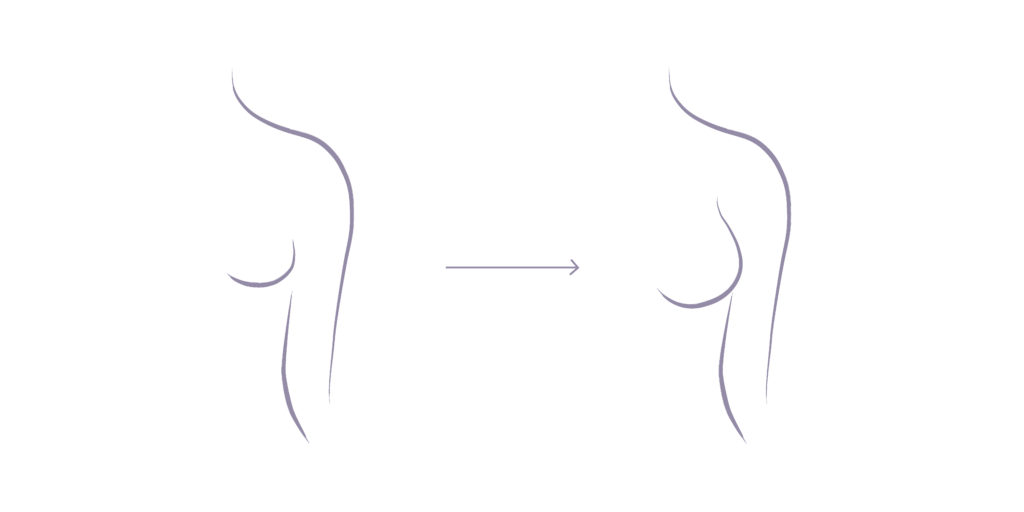
Hybrid breast augmentation combines breast implants with fat transfer to the breasts in the same surgical plan. The implant provides a stable foundation for volume and projection, while fat is used to refine shape, soften transitions, and sculpt the final contour.
This approach is often described as “the best of both worlds”. Implants can create central projection and structure, while fat can be placed in targeted areas to improve softness and contour where required. At Me Clinic, Hybrid breast augmentation is performed by Specialist Plastic Surgeons.

What concerns can hybrid breast augmentation help with?
Hybrid breast augmentation may be considered if you want:
- More breast volume and shape, with a softer and more natural transition through the upper breast and cleavage area
- Improved contour in areas where implants alone can look more defined at the edges, particularly in thinner patients
- Better tailoring of breast shape, including upper pole fullness and cleavage refinement where suitable
- A more sculpted result when implants alone may not address contour goals
- A plan that reduces the need for a larger implant to achieve the desired look
Hybrid augmentation is not a guarantee of cleavage or a specific breast shape. Anatomy, chest width, tissue thickness, and skin elasticity influence what is achievable.
Benefits of hybrid breast augmentation …
Potential benefits may include:
- Projection and shape support from a smaller, more conservative implant choice
- Smoother contour and softer transitions through the cleavage and upper breast, where clinically appropriate
- Reduced visibility of implant edges or rippling in patients with thinner tissue coverage, in suitable cases
- More refined sculpting, with fat used to “fine tune” specific areas rather than relying on implant size alone
- Added contouring benefit from the fat-harvesting step (liposuction donor sites)
Outcomes vary. Fat survival is not fully predictable and a portion of transferred fat may be reabsorbed during healing.
Am I a suitable candidate?
You may be suitable for hybrid breast augmentation if you:
- Want breast enlargement with shape refinement rather than relying on a larger implant alone
- Have enough donor fat available for transfer (commonly from areas like the abdomen, flanks, hips, or thighs)
- Are in good general health and suitable for surgery and anaesthesia
- Have realistic expectations about scarring, recovery, and the fact that fat survival varies
- Understand that additional fat transfer may be considered in some cases to build volume gradually
Hybrid augmentation can be a useful option for patients with tighter, younger breast tissue who want increased projection, and for those who want a more sculpted contour or added softness around implant borders. Suitability is confirmed during consultation with a Specialist Plastic Surgeon.
For women seeking greater size change, clearer projection, or a more straightforward volume-based approach, a regular breast augmentation (breast implants) may be the more suitable option.
Patients who want a more modest increase in breast volume without implants, and who have enough donor fat available, may benefit from fat transfer to the breasts.
What the procedure involves
Your journey starts with a consultation and assessment with a Specialist Plastic Surgeon. This includes discussing your goals, reviewing your anatomy and breast measurements, assessing tissue thickness, and checking whether you have adequate donor fat for transfer. Your surgeon will also explain what outcomes are realistic for your body and what risks to consider.
Surgery is performed in an accredited hospital under general anaesthesia. The procedure typically involves:
- Placement of an implant selected to provide the desired foundation for volume and projection
- Liposuction to harvest fat from donor areas
- Processing of the harvested fat, then careful placement of the fat into specific areas of the breast to refine contour, soften transitions, and improve overall shape balance
Fat is placed in a strategic, layered way to support survival and smoothness. Some patients benefit from a staged plan where fat transfer is refined in a later session, depending on goals, donor fat availability, and healing response.
Do I require a GP referral?
Yes. A GP referral is required before seeing the Specialist Plastic Surgeon for cosmetic surgery.
Recovery after hybrid breast augmentation
Recovery depends on the implant component, the fat transfer component, and the extent of liposuction required for fat harvesting.
Common recovery expectations include:
- Swelling, tightness, and soreness in the breasts and donor areas in the early weeks
- Bruising that can occur in both donor and breast areas
- A gradual settling phase where shape continues to refine over several months
Many patients with desk-based work plan around 1 to 2 weeks before returning, while physically demanding work may require longer. Exercise restrictions vary, and your surgeon will guide return to training based on your healing. Donor-site recovery can be a significant part of the overall downtime, depending on how much fat is harvested.
Results timeline
Early changes are visible, although swelling can temporarily affect shape. Typical settling patterns include:
- Early swelling improves over the first few weeks
- A more reliable shape is often seen over 6 to 12 weeks
- Ongoing refinement can continue over 3 to 6 months
Fat survival varies. A portion of transferred fat may be reabsorbed during healing, which is why some patients consider a second fat transfer session if additional refinement is desired.
Potential risks and complications
All surgery carries risks. Hybrid augmentation includes risks related to implants and fat transfer. Potential risks may include:
- Infection, bleeding, fluid collection, delayed wound healing, or scarring
- Changes in nipple or breast sensation, often temporary but sometimes longer-lasting
- Implant-related risks, including malposition, capsular contracture, or the need for future revision surgery
- Fat transfer risks such as fat necrosis (firm lumps), oil cysts, contour irregularities, asymmetry, or calcifications
- Donor-site risks including bruising, swelling, irregularities, or changes in sensation
- Anaesthesia-related risks
Your surgeon will explain your individual risk profile and how risks are reduced based on your anatomy and surgical plan.
How much does a hybrid breast augmentation cost?
Hybrid breast augmentation fees vary depending on:
- Implant selection and surgical complexity
- Amount of liposuction required and number of donor areas
- Hospital, theatre, and anaesthesia fees
- Whether additional procedures are included, such as a lift
A personalised quote is provided after assessment once your surgical plan is confirmed. Surgeon’s fees for a hybrid breast augmentation start at $16,500.
Medicare eligibility
Hybrid breast augmentation is typically performed for cosmetic reasons, so Medicare rebates are not usually available. If surgery is being considered for reconstructive reasons, eligibility may be discussed and assessed on a case-by-case basis depending on strict criteria.
Surgical Warning: Any surgical or invasive procedure carries risks. Before proceeding you should seek a second opinion from an appropriately qualified health practitioner.
Read more on the Risks of Surgery
What makes hybrid augmentation different from implants alone?
Implants provide predictable volume and projection. Hybrid adds fat transfer to refine contour, soften edges, and sculpt areas like the cleavage or upper breast where suitable.
Why not just use fat transfer alone?
Fat transfer alone can give a subtle, natural enhancement, but it does not create the same structural projection as an implant. Hybrid can achieve projection with a smaller implant, then refine shape using fat.
Can hybrid augmentation improve cleavage and upper pole fullness?
It can help in suitable patients by allowing strategic placement of fat to refine contour. Cleavage and upper pole results depend heavily on anatomy, chest width, skin, and tissue thickness, so outcomes vary.
How much bigger will I be after hybrid augmentation?
This depends on implant choice, the amount of fat that can be safely transferred, and how much of that fat survives. Your surgeon will discuss a realistic size goal during consultation.
Will all the transferred fat survive?
No. A portion is commonly reabsorbed during healing. Your surgeon will plan with fat survival in mind, and some patients consider a staged approach if additional volume or refinement is desired.
Do I need to have enough donor fat?
Yes. Donor fat availability is essential. If you are very lean, your surgeon will advise whether hybrid is feasible or whether an alternative plan is more suitable.
Is recovery longer than implants alone?
Recovery can feel more involved because you are healing from both breast surgery and donor-site liposuction. Many patients find donor-site soreness and swelling are a significant part of early recovery.
Can hybrid augmentation reduce rippling or visible implant edges?
In suitable patients, fat grafting may help soften transitions and improve tissue coverage. It is not a guarantee, and suitability depends on anatomy and tissue quality.